
First Ride: The Norton Atlas Apex Is Exactly What The Company Needed and Redefines Value
Iceland is most definitely the place to test Norton's new Atlas Apex.
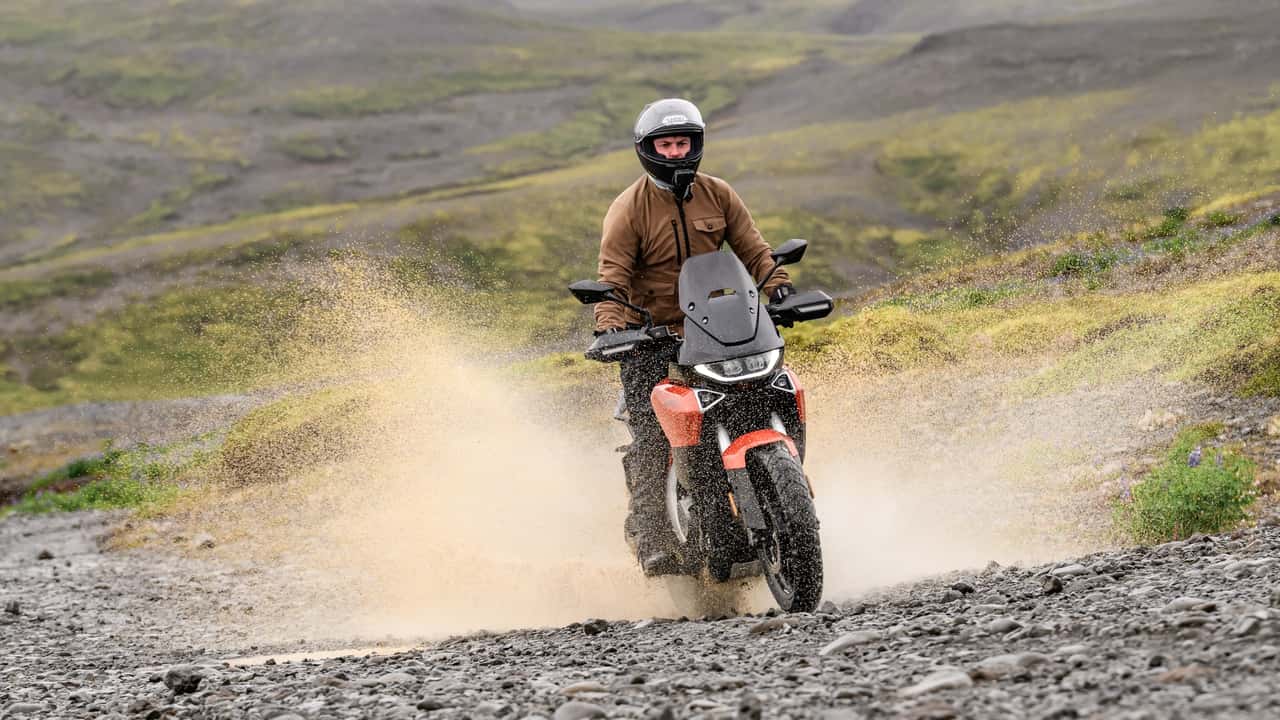

As I tried to look out from my windowless seat somewhere over Iceland, the weight of Norton’s new Atlas Apex hit me: This is the bike to make or break the company’s return.
If we’ve learned anything over the past few years, it’s that the motorcycle brands growing year over year are the ones dominating entry-level segments, like Kawasaki with its Ninja 500. Although the Atlas Apex, which is a step up in terms of features compared to the standard Atlas, isn’t an entry-level bike per se, it’s not far off.
The Manx R made all the headlines and magazine covers, but it’s the Atlas that has to sell in bulk if Norton is to climb back to the top of the totem pole. On paper, this middleweight ADV bike reads like a pretty good all-rounder. The problem with all-rounders is they’re never particularly great anywhere, but good at everything. So if the foundations are shaky, so too are the sales.
I felt the weight of what this bike means for Norton as I touched down in horrendous weather in Reykjavik. With monstrous crosswinds, persistent rain, and off-road trails ahead of me, I knew the Atlas Apex would have nowhere to hide.
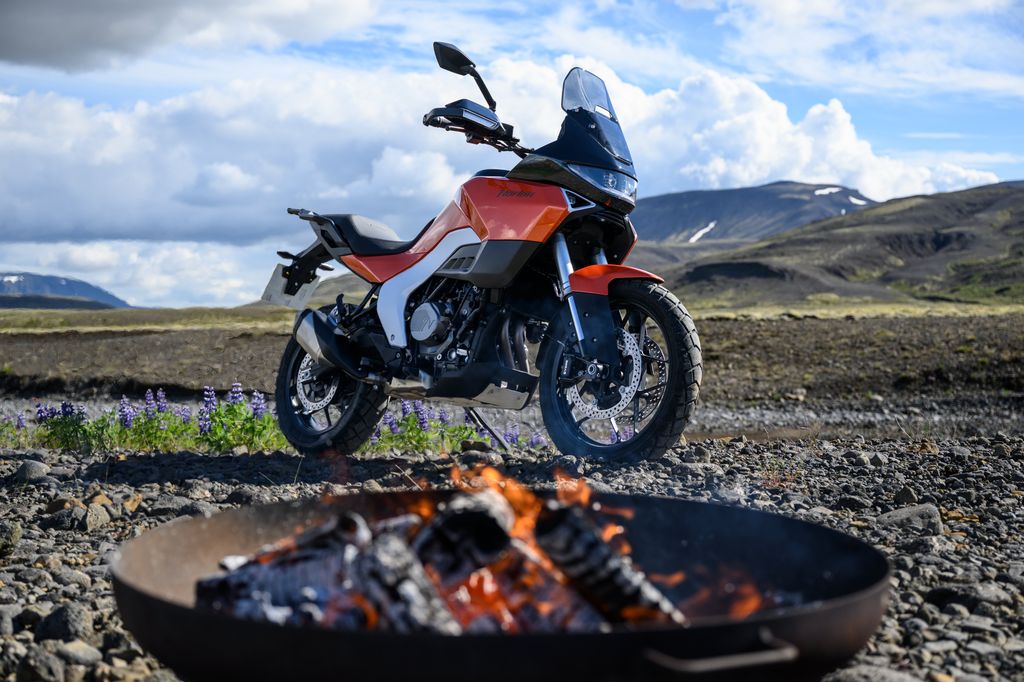
Feature-Laden
I’d tell you to hold your breath until I finish listing the features on the Atlas Apex, but I fear you’d wake up over a broken keyboard. Nothing in this category compares to the Atlas Apex in terms of equipment. I’m not even sure that anything in this class is as feature-laden as the standard Atlas.
Though I’m not going to go through every feature because this isn’t a top trumps competition, some have to get a mention: most for the right reasons, but some for the wrong ones.
The Bosch 6-axis IMU is a fantastic bit of kit to get at this price and enables the lean-sensitive ABS, cornering traction control, wheelie control, and rear slide control. For the most part, we probably don’t see so much tech in this category because it verges on overkill. However, as the wind howled through my visor and rain soaked my waterproof jacket and four layers beneath, I was thankful for most of the rider aids at one stage or another throughout the day. I was happy to have the ABS and TC active as I explored grip levels at the start of the day, but I could take or leave the wheelie control on a middleweight of this stature.
Somewhere along the way, I turned on the cruise control, which also uses cornering cruise control. If you don’t know what cornering cruise control is, you’re not alone, because I didn’t. Basically, because motorcycle tires have a lower radius when they’re leaned over, you could enter a long right-hand turn using regular cruise control at 70 mph and exit at 60 mph, but not on the Atlas. The Atlas’s cornering cruise control kept my speed constant throughout the ride and, since there were many 60 mph stretches that included long but gentle bends in the road, I came to appreciate this new-to-me feature.
As the day progressed, I got involved with the aforementioned rider aids and the five ride modes—Urban, Rain, Sport, Tour, and Enduro—via the 8-inch 720p full-color touchscreen TFT dash. The TFT dash brings a premium feel to the riding experience on the Atlas; it’s bright, and the colors are vivid, which was a godsend whenever I glanced down through a wet visor. It’s a surprisingly easy system to navigate. The thing is, all the features mentioned thus far are available on the standard Atlas, but it’s the features only available on the Apex edition that made the weather conditions much more bearable.
Simple but effective 3-level heated grips kept my hands toasty while the handguards kept the wind off them. There were plenty of stops and starts throughout the day, but rarely on level ground, and I found myself becoming more and more grateful for the Hill-Hold assist. Whenever I came to a complete stop using the front brake, the Hill Hold applied pressure to the brakes and didn’t release it until I engaged first and pulled away. I didn’t get to fully make use of all the features during the ride, but the cornering lights and rear luggage rack made me daydream about extending the trip and taking this adventure bike on a proper adventure.
Not all of the Atlas Apex’s features were slam dunks, however.
Take the 3-way adjustable windscreen, which was easily adjustable with two hands but impossible with one, so I needed to pull over if I wanted to change it. I will say, though, the buffeting was far less than expected for a bike in this category, so hats off to Norton here. The quickshifter was also fine but not great, as the shifts were a bit clunky unless I hit the sweet spot at about 5,000 rpm. It was only when I switched the quickshifter off that I found out how silky the gearbox is, which resulted in me keeping it off, apart from on the off-road sections where it was a godsend for a relative off-road noob like myself.
The tech on the Atlas falls into three camps: the good, the OK, and the ugly. Thankfully, the final camp is sparsely populated.
Depending on the type of motorcycle, a keyless ignition can make life notably easier—that’s not the case on the Atlas. The keyless ignition on the Atlas doesn’t work like any I’ve used before, as I needed to take the key out and unlock the bike before turning it on, or use a proximity feature whereby the key needs to be held very close to the ignition. Either way, it didn’t make life any easier; if anything, I’d say it gives all the negative aspects of a keyless ignition without any of the positives. While this was a bit annoying, at least it didn’t interfere with how the bike performed, unlike my other quibble.
All Things Norton
There’s a rider aid called Dynamic Torque Control, which is essentially an engine brake management system. At the start of the ride, I felt like something was slightly off with the bike, like my inputs were distorted or diluted. But it wasn’t until I faced some downhill sections that I was sure that my inputs weren’t translating as they should. When I was shutting the throttle before hitting a downhill bend, it almost felt as though the throttle bodies opened or didn’t shut as they should. Getting extra pep exactly when I didn’t want it gave me some semi-squeaky bum moments.
As soon as I turned off Dynamic Torque Control, it was transformative. I felt more connected to the motorcycle and realized the bike’s foundations are solid. Then I wondered, “If I turned off more of the electronic aids, would the bike get even better?” The answer is yes, to a degree.
Less is More
As I peeled back the electronic aids and let the nuts and bolts of the Atlas Apex lead the way, the bike got better and better. By the end of the ride, I was in Enduro mode (no TC or ABS), the quickshifter was off along with the Wheelie Control and Dynamic Torque Control, and it was the most engaging the bike had felt all day. But then, why wouldn’t it? The hardware package is fantastic.
The all-new engine that has been designed specifically for the Atlas is a little hoot. On paper, a 585cc liquid-cooled parallel twin with a 270-degree crank might not light a fire under you, but on the road, it’s a different story. For this engine configuration and size, the peak power output of 69 hp at 9,300 rpm makes it surprisingly peppy when you get it spinning, but that only tells half the story. The Atlas makes 42.4 lb-ft of torque at 7,300 rpm, but since the torque curve is fairly flat, there’s decent power almost everywhere in the rev range, but it’s never intimidating. The Atlas’s broad torque curve was nice on the road, but more useful off-road.
The best way I can describe the Atlas’s off-road abilities is that it feels easy to ride for someone who can count their off-road mileage per year with double digits. The power was everywhere, but it was never too much, although the initial throttle pickup was somewhat jerky. There was more than enough to get the back end out whenever the mood struck, but I wouldn’t be able to speak to that if the chassis didn’t give me the confidence to act silly. And I’ll tell you that I didn’t receive any awards for riding sensibly off-road.
The fully adjustable KYB suspension at the front and rear kept the Atlas feeling planted as I tried to upset it on what I’d describe as fire roads, covered in volcanic soil. It certainly wasn’t the most extreme off-road riding I’d ever done, and I don’t think the Atlas would be up for much more, but I was appreciative of the bike's low center of gravity and the effort the engineers had put into mass centralization. As I tried to pin it sideways through any bend in the dirt road I could find, the steel trellis frame relayed what the bike was doing to me, via its frame flex, which was engineered rather than the result of a soft chassis.
On road, the Atlas performed well in just about every scenario you’d likely find yourself in on a middleweight ADV bike. The KYB suspension that soaked up the off-road bumps kept the road ride relatively comfy, and the upright ergos and relatively low—for the category—seat height of 845 mm did nothing to hamper the suspension's efforts. After about 140 miles in the saddle, nothing ached. I can’t comment on how the suspension reacts when you really push it on the road because the weather was too bad for those antics, but at a moderate to quick pace, there are no concerns. The first, long, fast bend produced a welcome surprise: the Atlas was happy, stable, and asking for more lean.
Through the city, it was more of the same—the Atlas was a breeze.
U-turns were more or less telepathic and happened in a much tighter radius than I expected. Helping the bike’s around-town manners is a rear brake that provides a good amount of stopping power very progressively and with plenty of feel for those riding in chunky off-road boots. Unfortunately, I can’t say the same about the front brakes.
Radial ByBre front calipers bite into twin 310 mm front discs through braided lines and, while not very bad, it’s the poorest performing component of all the hardware. There was almost no bite when I first pulled the lever, and I didn’t get the stopping power I was looking for until I squeezed significantly further than I expected. It’s as though 90% of the stopping power is in the last 10% of the lever's range of motion and, unfortunately, that doesn’t translate to a very progressive braking system on the road. Off-road, however, it’s a different story.
You don’t want a strong initial front brake bite when riding off-road, as it’s easy to tuck the front. When I was riding off road, the brakes made so much sense; I never feared that squeezing a smidge too much would result in a visit to the ER. I actually felt confident sinking the anchors off road on a bike that weighs 423 lbs (dry), and it’s all down to how the engineers designed the brakes to react. I’ll leave it to you to decide whether on-road or off-road performance is more important.
My Verdict
I don’t know what I expected from the Atlas, but I know I wasn’t expecting what it is: Accessible in every sense of the word.
From throwing a leg over at my hotel, to leaning 30 degrees just to go straight in hellish crosswinds, and kicking up dust on volcanic soil, the Atlas was as easy to ride as it was fun, whilst remaining unintimidating and more capable than expected.
Maybe it’s the fact it’s a Norton or that it’s dripping in features rarely seen in this category, but I expected some aspects to be extreme; none were. Meaning you're left with a Norton that’s dripping in features you won’t find on any other bike, and that’s not a bad thing to have in your garage. Then there’s the price.

There’s no official US price yet, but in the UK, the Atlas Apex is listed at £9,450, which equates to around $12,760. A Norton executive told me that the brand has never competed on price, and it won’t start with the Atlas. But if you look at the middleweight ADV category, the Atlas Apex would be one of the cheapest, while also being the most feature-packed. That said, it never feels built to a price. From the well-designed switchgear to the smooth bodywork and the puddle light showing the Norton logo, I never felt like this was anything other than a bike from a top-tier brand.
The Norton does compete on price extremely well, but nothing about the riding experience made me feel like that was its purpose. Its price feels more like a byproduct of TVS’s relationship with third-party manufacturers, and we reap the benefits. For the money, the Atlas Apex makes a serious argument for a one-bike garage, especially for riders racking up high yearly mileage. Whether you’re looking for an all-rounder for your first big bike or a seasoned rider who’s sick of moderating your right hand, this deserves a look.
The bike isn't without fault, and I'd be remiss if I didn't tell you that I experienced a few electronic glitches while riding my pre-production bike, but I'm hopeful that these issues, along with the throttle jerkiness, will be sorted by the time these bikes hit showrooms. The fact remains that it is the most accessible Norton ever, not just financially but in terms of ridability, and in no way does that equate to boring. Quite the opposite. And it has me hopeful for the future longevity of the brand, and less weight on my shoulders.

RECOMMENDED FOR YOU
Norton Just Won Another Design Award By Refusing To Make Its Superbike Look Like A Fighter Jet
This Electric Motorcycle Was Almost Vaporware. Now It Wants To Conquer America
A Single-Track Hero Made For Kids, But Plenty Fun For Adults: 2026 Zero XE Review
Not Everyone's Happy About King of the Hammers' New Proposed OHV Trail
Norton Brings Historic 1953 Manx to Goodwood Revival To Compete in Barry Sheene Memorial Trophy
This Giant Scooter Proves Why You Shouldn't Give Up On Your Projects
Norton Is Already Delivering Its All-New Adventure Bike