
Working The Land Helps Remind You That We're Only Its Current Stewards
Manual labor has a habit of helping remind you of your place within this long train of history.

This isn’t mine.
The crumbly dark dirt underneath my nails. The song birds whistling in the trees. The ants crawling beside me as I pull invasive mustard garlic. And neither the warm sun above.
It’s my children’s. It’s their children’s. And it’s every child’s after them.
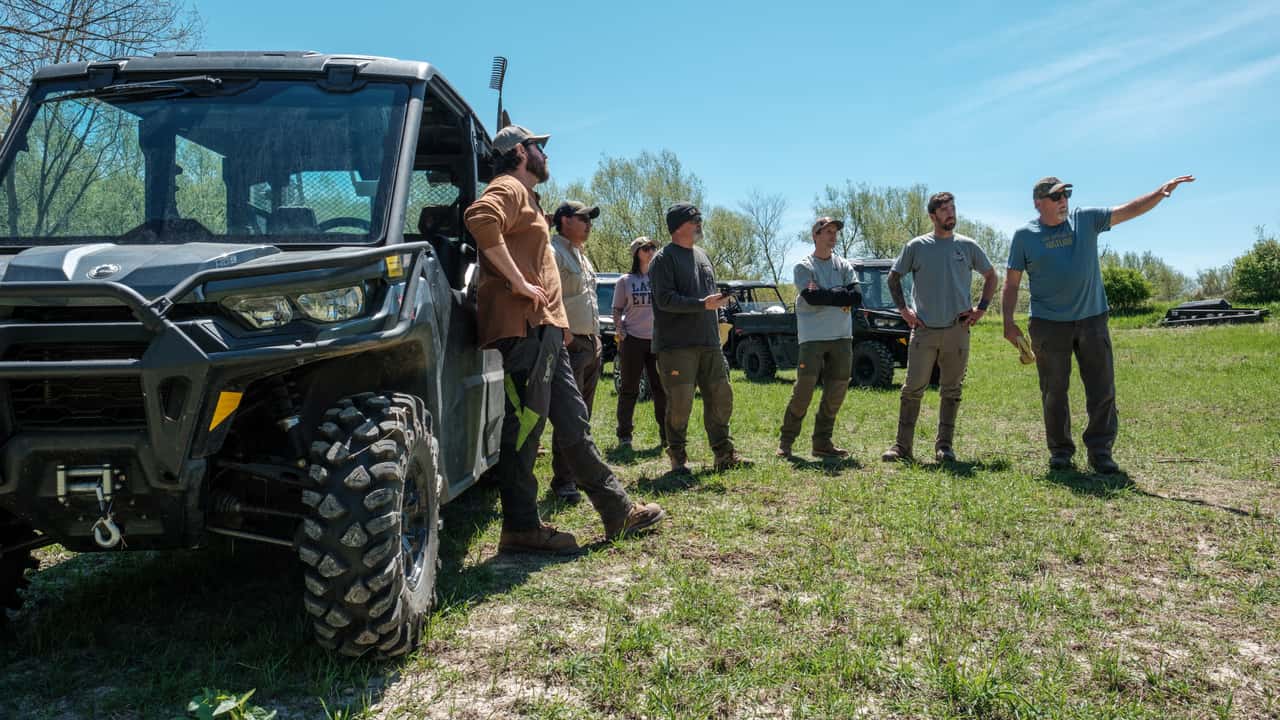
Manual labor, even that which is supported by Can-Am's modern UTVs and ATVs, has a habit of restoring some semblance of peace and also helping me find balance in an otherwise chaotic world. Here, working on a sun-drenched hillside on Doug Duren's farm in Cazenovia, Wisconsin, as well as the great conservationist Aldo Leopold's old farm, a place where he wrote his seminal work, there's little of the outside pressures of reality that are allowed to work their way into my mind. Few things disrupt the task of the land stewardship that aims to restore this rolling landscape to what it was before Duren's family, generations ago, acquired it with the purpose of supplying their saw mill with raw material and carving their farm into its landscape.
Few people are born conservationists. Few are born stewards. But we're influenced throughout the years. Through song, prose, books, and people, we're molded. Shaped. Carved out with imprecision and passion. For Duren and his partner in Sharing the Land, Lyndsey Braun, Leopold was their beacon. For me, it was Bill Watterson, who himself was influenced by Leopold. Behind me as I type, both Leopold's A Sand County Almanac and Watterson's The Essential Calvin & Hobbes sit proudly.
The breeze cools my warm skin atop the hill. It overlooks the Driftless area surrounding me. The red and black oaks tower above me, providing me a small reprieve of shade from the beating sun. They give home to squirrels and owls and robins and spiders. The grasses, which have grown tall after the mild winter, sway to and fro in the light wind.
There’s no ownership here. Not really. No mine. No yours. No ours. But it isn’t that either.
A Land Ethic
Duren and Braun's Sharing the Land initiative works to ensure that private land owners, which make up most of the land owners in the United States, aren't being left out of the conservation narrative. Whereas many conservation and stewardship groups eschew these folks in favor of highlighting public lands—which is important to say the least—stewardship often starts and ends with private land owners, as without them, you can't hope to achieve the goals of reclaiming the land that once was.
Easements, native flora reclamation, irrigation and riverine restorations, the resurrection of prairies, and even the bison wouldn't have been possible without private land owners and their cooperation. Yet, without help and support, there's none of this. And without the public engagement, it doesn't happen either. Sharing the Land, through connecting public citizens with private land owners in exchange for helping these restorative projects for access to said land, helps to bridge the gap between the parties, while also connecting people to the lands they inhabit. And, hopefully, it also returns some semblance of Leopold's own Land Ethic to all those involved.
It's fitting that the day prior, we were working to help restore and maintain Leopold's old shack and farm in Baraboo, Wisconsin, which is about an hour from Duren's family farm.
Leopold came here with his family nearly a hundred years ago. The farm, which originally sat on 160 acres, was the family's summer getaway. It gave Leopold countless lessons on biological diversity, the history of the region's ecology, a place where he could experiment with his thoughts on habitat restoration, and thoughts that culminated in A Sand County Almanac, something that he unfortunately didn't live to see published. He learned that it would be printed just two weeks prior to his passing, which occurred on this very property as he fought a wildfire.
Long after we’re gone, long after humanity, long after everything returns to its original form, the dirt that's underneath my nails, the birds singing above, the prairie savanna I’m helping to restore, it’ll still be here.
Hopefully.
Hopefully here to rejuvenate your soul. To provide a home to the animals that inhabit its confines. To purify the air, water, and ground. To be as it was and that which it will always be. Home, respite, restorative, and endless.

Sharing the Land's Lyndsey Braun and Doug Duren.
Collectively, we're currently at a crossroads in our land stewardship here in the United States. The little public land we have left is being developed at a faster and faster pace. The private land that was once that of farmers or under generational ownership is being bought up by private equity, banks, or technocrats who aim to throw data centers onto it. And through it all, most people have forgotten our connection to these lands we inhabit. How we're a part of the ecosystem ourselves, not above it.
Through cooperative models like Sharing the Land, as well as a number of others, more and more people are aiming to help restore our connection to these places. To restore our connection to wildlife. To restore our connection to nature. And I'm hopeful that it'll work, as without these organizations, projects, and cooperation, Leopold, Duren, Braun, and even Watterson's wonder for the natural world will fade into the annals of history.
Yet, if history's our great teacher, that only ends one way: ruin. Not for the land, but for us. After all, we're but a speck in time.
I don’t own this. You don’t own this. Paper would say otherwise, but you can’t own the rustling of the leaves, nor the songbirds within them, nor the deer fawns walking through the meadows below. But we can’t neglect it. We can’t push its stewardship down the road. We can’t make it our children’s jobs. Or their children’s. Or their children’s children’s.
So in a way, it is ours, too. Owned, but only for a spell.
The cool wind blows the sweet, treacly smell of wildflowers across my face, reminding me my break is done. Work resumes. Work that will ensure everyone has this. To feel that wind, that sun. To hear those birds, those leaves. To breathe in the air, feel rejuvenated, and do their part, too.
To do better. To leave it better. To be the stewards we were always meant to be, but maybe forgot about.
RECOMMENDED FOR YOU
Pro Hunter Chris Bee Tells Us Why EV UTVs Are The Future. And How His Can-Am Makes Everything More 'Efficient'
Vespa Might Mean 'Wasp,' But Right Now It's A Bee Going From Flower To Flower With Its Latest Luxury Collab
Here's How You Can Get More Horsepower In Your New Can-Am Defender
I Got A Real-World Taste Of The New BMW F 450 GS, And I Want More
Can-Am Will Donate Money To OHV Trail Projects If You Complete This Safety Class
A KTM Superbike Engine Powers This Insane Custom Motorcycle That Debuted At Goodwood
Driving UTVs In The Arizona Desert Will Absolutely Take Your Breath Away