
Here's Why Polaris Is Working on Autonomous Side-By-Side Systems
When the U.S. Army says "jump," you say "How high?"
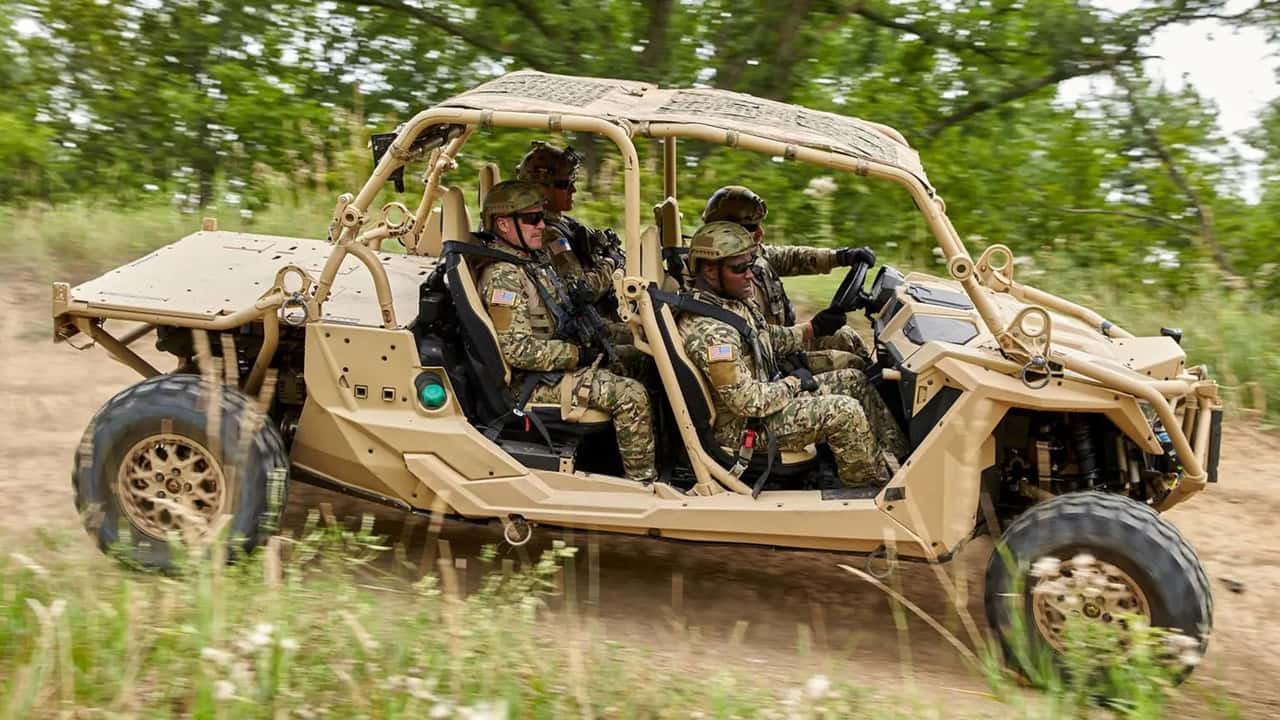

A few days ago, we reported that Polaris had filed patents related to autonomous vehicle systems and that the system itself could be either remotely controlled or used in a fully autonomous mode. And in that story, RideApart posited that the patent was likely for the company's military and defense business, as it would allow the aftermarket to lead in developing autonomous vehicle systems for its MRZR platform.
Still, it could've been just another command-and-control module for parking, as we've seen those patents from the company in the past. However, it wasn't likely, as the patent's details revealed that a lot of emphasis was put into driverless controls and remote operation. It seems that we were correct in our assumption, too.
It was recently announced that the United States Army's Unmanned Systems (UxS) autonomy program had gone through what Breaking Defense calls a "restructuring" as of late, in that they were set to replace General Motors' ISV platform with... you guessed it, Polaris' MRZR side-by-side.
Damn, we're good at this.
Go Heavy, Go Hard, Go Loud
While GM's ISV is a stout product, one that I'm sure many in the civilian world would love to own, it's still just a skeletonized Colorado ZR2, and that poses limitations on its capabilities, as well as what autonomy software is most easily integrated into its control systems. Polaris' MRZR, however, is a far more simple machine, but one with capabilities that far exceed its smaller size. As such, while initially favoring the ISV for being the test bed for folks like Forterra, Overland AI, and other contractors, the Army later rescinded that requirement and has now abandoned it fully.
Speaking with Breaking Defense, Michael Rose, the chief technology officer for CPE Mission Autonomy, told the outlet, "The important thing here is continuing what the RACER program started, which was like, ‘What’s the best you can do in off-road autonomy?'" The RACER program (Robotic Autonomy in Complex Environments with Resiliency) is a DARPA joint, which really kicked off a lot of the unmanned ground vehicle autonomy that we see today. But the idea is to build an off-road-capable autonomous vehicle that can withstand the rigors of war, and is the predecessor to what we've already seen introduced into combat situations.
The switchover, however, was designed to get a baseline for all the contractors and see how each stacked up against one another given a level playing field. That makes sense, as if you have one contractor using an MRZR and another using the ISV, that's not exactly apples to apples.
Breaking Defense also reported that, like we mentioned above, the Polaris MRZR platforms are far simpler to integrate autonomous systems into, as an off-the-record source told them that ISV integration was proving expensive and that there were "underlying deficiencies." Again, the ISV is a heavily modified consumer truck, and those systems can be a pain to work around. The MRZR, on the other hand, is basically an old-school Willys Jeep at its core.
While the outlet speaks about the outside contractors working on autonomous MRZRs, it doesn't mention Polaris as one. But given the company is already a government contractor, and its work with autonomous systems in the past, it's far more likely that it, too, is going for the contract itself, and that last patent is the first step toward it. At least, that would make the most sense.

RECOMMENDED FOR YOU

This Polaris Is Trusted By 50 Militaries, And Belgium Just Bought $10 Million Worth of Them
Kawasaki Versys 900 Spied Testing in the Wild. New Team Green Bike Incoming
Polaris' New UTV Has More Horsepower Than Subaru's WRX. Rally Nerds, Rejoice
Royal Enfield Is Coming For Bigger Bikes, And Motoverse Could Be Ground Zero
Polaris Wants To Give Someone $50K. You Just Have To Beat Its Entire Factory Racing Team To Win It
Trackhouse MotoGP Says They're Hiring a Racer. Maybe We Should All Apply?
Driving The 2026 Polaris Xpedition Is Good. But I Wanted It To Be More For The Price