
The New Royal Enfield Himalayan 750 Asks the Question, "Is More Better?"
Does a bigger engine, slightly more ground clearance, and not much else deliver a better experience than the Himalayan 450?
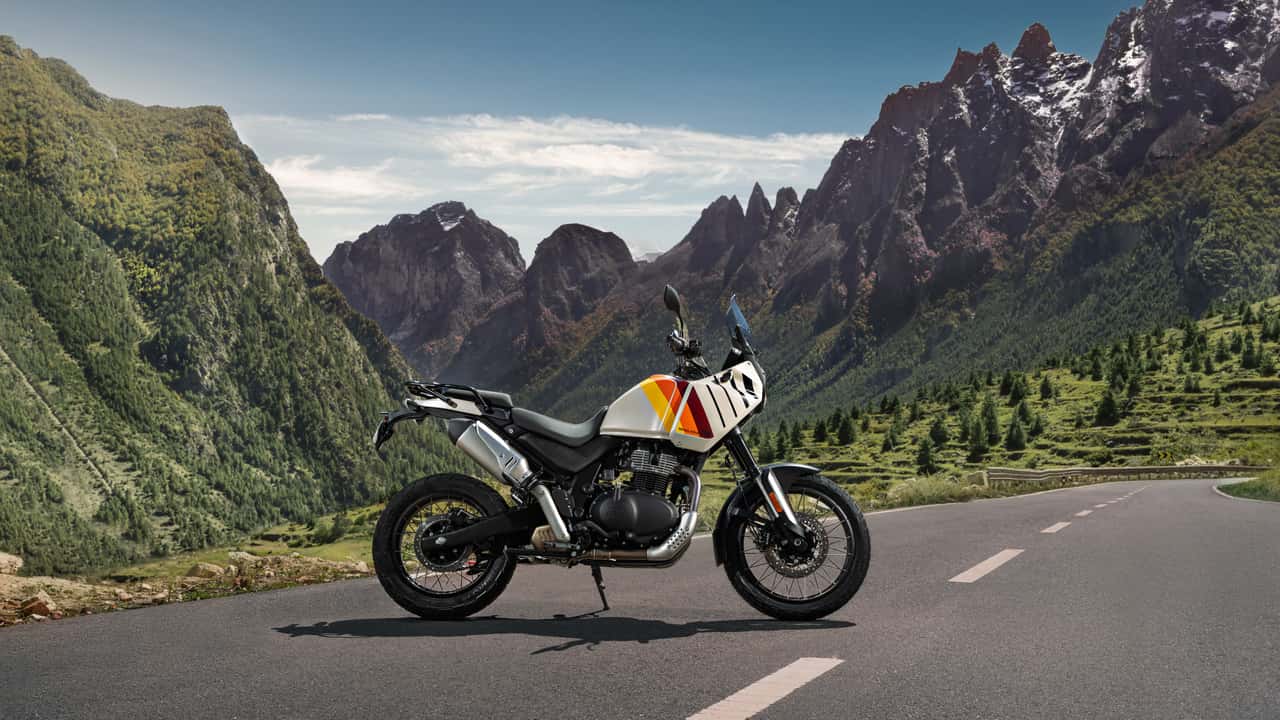

Apologies to the Christians, the Muslims, the Jews, the Buddhists, or whichever god you pray to in RideApart's audience. My one true god remains, and always shall be, the Royal Enfield Himalayan 450—Praise be.
It remains the motorcycle I think of whenever I'm asked, "What vehicle I've tested in recent years was your favorite?" More so than anything go-fast. More so than anything utility-based. More so than anything, it's that stupid simple, pint-sized, quasi entry-level motorcycle that I fixed with a literal stick when I binned it coming out of a soupy-ass mud puddle. It is, in my eyes, perfect in every way. Nothing you could do to it would make it better. Not more horsepower. Not more travel. Nothing. It remains one of just three posts pinned to my Instagram, and the only one not with a dead animal.
I, however, seem to remain the only one that believes this, as while a host of accessories have popped up since its launch in the aftermarket, the biggest change the Himalayan platform is set to see is this: the 2027 Royal Enfield Himalayan 750.
Yep, Royal Enfield has expanded the Himalayan offerings once again, slapped a bigger engine into its chassis, gave it some more travel and ground clearance, and aims to compete with other middle-weight adventure and touring motorcycles on the market. But like the recently announced 2027 Kawasaki KLE650, I have to ask, do we need more more? Is more of everything better?
...I'm not sure about that one.
Gallery: 2027 Royal Enfield Himalayan 750

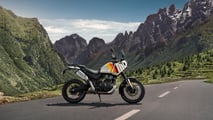
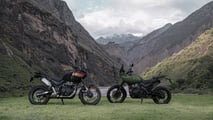
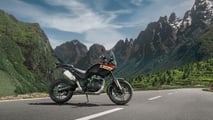
Slow Bike Fast Is Better Than Fast Bike Slow
So let's get the specs out of the way first so we can then get to my thoughts on them. First, as you'd likely guess, the engine powering the Himalayan 750 is a 743cc air/oil-cooled parallel twin, no fancy-pants water cooling here. And that's makes a lot of sense, as it's lighter, less complex, and you can't crack a radiator doing something dumb in the mountains. Stupid simple, a hallmark of every Himalayan ever built. Horsepower is 54, while torque is said to be 47 pound-feet. And that last one is important for off-roaders.
That's about 17 more torque than you get in its 450 baby sibling, and 22 fewer than the 440.
It's also a reasonable amount given you get nearly all of that torque at 3,500 rpm. For those who don't off-road all that much, having all that torque lets you just chug along, climb obstacles, and keep your footwork to a minimum, thereby letting you focus on your lines, your braking, and your throttle control—the latter I clearly sucked at during the 450's launch. Riders will also get a 4.5-gallon fuel tank for extended rides, stability and traction control, cornering ABS, dual disc front brakes, a 32-inch seat height, and a whole new design that looks very Husqvarna Norden-inspired. You also get cruise control, and that seems to really point to where Royal Enfield wants to pull potential riders from with this specific Himalayan: Touring. Which, to me, sounds not like a Himalayan at all.
See, highlighted in Royal Enfield's press release are two big items: Touring DNA and Dynamic Precision. The first speaks for itself, as Royal Enfield goes on to speak about the Himalayan 750's "accessible seat height" and touring accessory seats, including one for a pillion, as well as its adjustable windscreen, 195-kilo payload capacity for boxes filled with gear, narrow waistline, and its forged controls. There's even a (gasp) cast set of optional wheels. But it's the second that really gives me pause on whether it earns the Himalayan nameplate.
2027 Royal Enfield Himalayan 750
Dynamic precision was never a part of the Himalayan. It's meant to be fixed anywhere, including the side of a trail and with whatever you have handy, whether that's the aforementioned stick or whatever tools a local has high in its namesake Himalayan mountains. Precision is often the opposite of simple, and you can see that in the specs Royal Enfield highlights, including its fully adjustable Showa USD front forks, its optional alloy wheels, and most notably, the 6-axis Inertial Measurement Unit, which Royal Enfield says includes a "three-axis accelerometer and three-axis gyroscope," which "constantly monitors linear acceleration, pitch, roll, and yaw [for] cornering ABS, lean-sensitive traction control, and other rider aids for maximum stability and safety."
That's a ton of tech. Great for a touring bike that'll never see off-road, but is that what makes a Himalayan? I don't know.
Maybe I was just too enamored by the basic, simple, purely perfect Himalayan 450 when I got behind its bars? Maybe I'm part of a cult? Maybe I'm the cult leader? Perhaps all are true, and I'm not giving the 2027 Royal Enfield Himalayan 750 a fair enough shake? It's all rather unclear until I get behind its bars and see for myself. Preferably back-to-back with my lord and savior, the Himalayan 450.
What I can leave you with is that it's priced right for the segment. All right, all right, it's priced incredibly well, with an MSRP of just £6999, which roughly translates to $9,400, at the current exchange rate. Royal Enfield said the true U.S. price won't be announced just yet, but given how close they've been to even exchange rates in the past, it'll likely be just under $10,000. That value cannot be discounted, and at that price, I can forgive a lot.
I just truly hope that it has the same DNA, that same feel, as its smaller sibling. A do-anything, perfect off-roader that can be beaten, battered, fixed with a stick, and carry on like nothing happened. Maybe even dragging a knee and drag racing some friends after said incident...
Amen.

RECOMMENDED FOR YOU
Royal Enfield's Himalayan 750 Is Already Around The Corner
Yamaha Finally Brings Out Its Own Giant Adventure Scooter, And It's A Brawling, Big-Shouldered Beast
Royal Enfield's New Classic 650 Changes Colors. But Refuses To Grow Up
Honda's Supercharged V3 Is Getting Closer To Production. And Things Are Getting Weird
Royal Enfield's Newest American Motorcycle Is Also Its Oldest… Kind Of
Polaris Is Doing Great, Actually
I Can't Wait To See The Build. Train. Race. Grid Slide Their New Bikes In The Dirt