
This State Just Passed Sweeping New E-Bike Legislation. Here's What It All Means.
The State of Illinois is coming for your SurRons and Talarias without saying it's coming for your SurRons and Talarias.


Over the past few years, e-bikes (and other micromobility devices) have been a game-changer for a lot of people. Classic bicycles, of the type our British friends would refer to as "push-bikes," skateboards, and other purely human-powered devices are still great, of course.
But if you're a motorcyclist with any sense of history, then chances are excellent that you're already aware that our favorite form of two-wheeled transportation got its start back when multiple people first said: "Hey, what if I took this engine and strapped it onto a bicycle?" And thus, motorized bicycles started to be a thing in the late 1800s, extending into the early 1900s and evolving into the motorcycles we know and love today.
In a way, e-bikes are an alternate refinement of this idea, except of course for the fact that they're powered by electric motors instead of gasoline engines, and they also rely on batteries. The execution may be different, but the idea is quite similar. Pedal bicycles present a certain bar to entry, whether it's fitness/disability levels or simply a dislike of getting super sweaty before you have to go give a big presentation. Enter the new-gen spin on motorized bicycles, the category colloquially known as e-bikes!
More To The Story
New Category, New Problems
I pretty much can't go anywhere now without seeing plenty of folks out riding e-bikes, whether I'm riding my own or not. I started riding e-bikes after a serious meniscus injury, one that ultimately required surgery and physical therapy to properly recover from. It's a lot of fun to hit trails I'd never discovered before, and to go further than I likely could or would on my pedal bicycle.
It requires a certain level of responsibility; but then again, so does motorcycling, right? Right.
Of course, I'm one person. How I live my life (and ride my bike, no matter what type it is) is how I live my life and ride my bike, and does not necessarily reflect what anyone else decides to do with theirs. As more and more e-bikes have hit streets, trails, and pretty much anywhere else they can, more and more city, state, and local legislators have been working to hash out regulatory frameworks for dealing with these new vehicles.
Like it or not, they're a fact of life for many. As with any vehicle, they can be used for good or for ill. The same mild-mannered car that takes you to work also has the potential to become a road rage weapon, you know? Add to that the fact that tons of kids (who, let's not forget, don't have fully developed brains yet and may not be making the very best decisions) are also riding e-bikes, and you have a potent recipe for potential and life-changing disaster.
I can control how I ride, but I can't control how anyone else does. And neither can you. From one perspective, that's what legislators all over have been working to hash out. Since I live in the state of Illinois, the sweeping new bill that's just gone through the state legislature regarding e-bikes is of particular interest.
I've read the full text of the bill , as well as the informational website assembled by the Illinois Secretary of State, associated press releases related to the passing of this bill, and local news stories that, rather frustratingly, have only served to heighten confusion instead of clarifying it.
All of that is why you're getting this explainer; because I'm a human person, not an AI aggregator, and these new laws also affect me (again, an Illinois resident) directly. I wanted to understand it better, and I'm hoping to help you do the same.
Here's everything you need to know about the new statewide e-bike and micromobility legislation in Illinois, which passed through both chambers of the state legislature, and was sent to the governor's office on June 30, 2026. Please note that at the time of writing on July 7, 2026, it has NOT yet been signed into law by Governor Pritzker, although most news outlets are treating this as a formality.
All The Rules We're Discussing Won't Go Into Effect Until January 1, 2027
First things first: Some local reporting about Illinois SB 3484 has misstated these changes as going into effect on July 1, 2026. I won't speculate on how or why this happened; instead, I will merely point out that it is factually incorrect.
In what way? Well, for a start, it only got sent to the Governor for his signature on June 30, 2026; and at the time of writing, he has not yet signed it.
In Illinois, as is the case in most US states, even if a bill passes through both chambers of the state legislature, it still requires the governor to sign off on it before it officially becomes a part of state law.
Let's Talk About The Illinois Definition Of A Low-Speed Electric Bicycle
Stay with me here, even though you may already be familiar with this concept. Basically, if you've heard about Class 1, Class 2, and Class 3 e-bikes, then you probably have some idea of what I'm about to say.
The state of Illinois defines all of these bikes as being capable of top motor-assisted speeds between 20 and 28 miles per hour. Here's how it defines those classes.
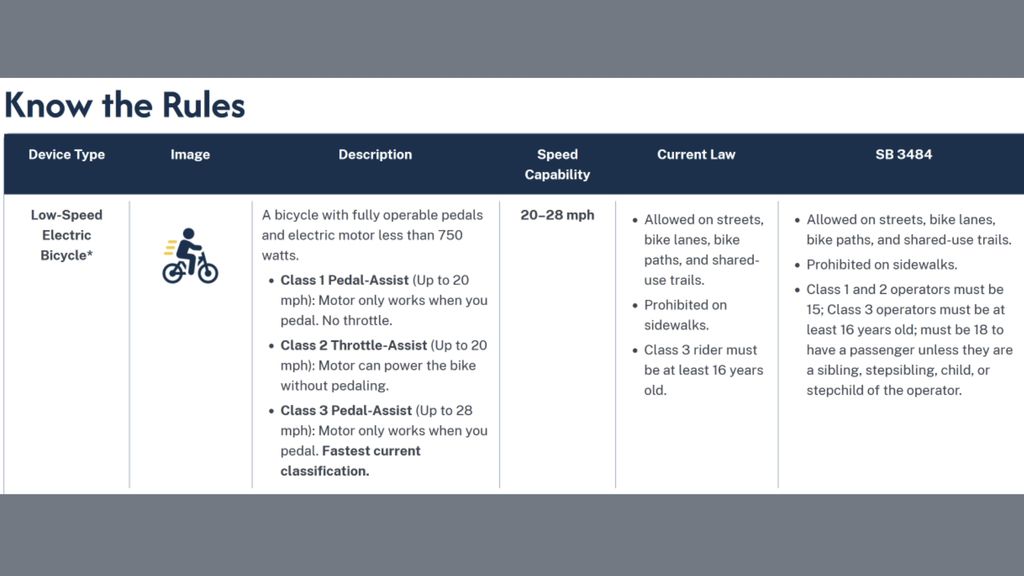
SB 3484, Which Would Go Into Effect In January 2027, Adds New Regulations For Talarias, SurRons, and Similar Go-Fast Electric Two-Wheelers
Again, I've seen some confusion in local reporting about these law changes, particularly when discussing new requirements for vehicle titles, registration, and insurance for certain electric two-wheelers. As usual, I'd like to clear that up so we're all on the same page. To do so, it's important to understand how the state of Illinois is drawing its lines around various vehicles.
The primary area that the state of Illinois aims to change is legislation of e-bikes with motors over 750W and under 8,000W (or the equivalent of between 1 and 10-ish horsepower).
In other words, bikes like your Talaria Sting MX3 (claimed nominal power of 3,000W and peak power of 6,000W) or your SurRon Light Bee S (claimed max power of 3,500W), or other similarly-powered equivalents from other brands. While these are all marketed and sold as electric dirt and off-road bikes, I know that I've seen them out on paved roads near me, and I'd bet that you probably have, too. In fact, their popularity amongst The Youths™ is a pretty regular topic of conversation in the RideApart newsroom.
These machines previously occupied a somewhat nebulous space between more sedate, pedal-powered e-bikes and full-on electric motorcycles. You or I might consider them to be light electric dirt bikes, but it's clear that in practice, not everyone has.
Here's how Illinois will regard these machines if and when SB 3484 goes into effect.
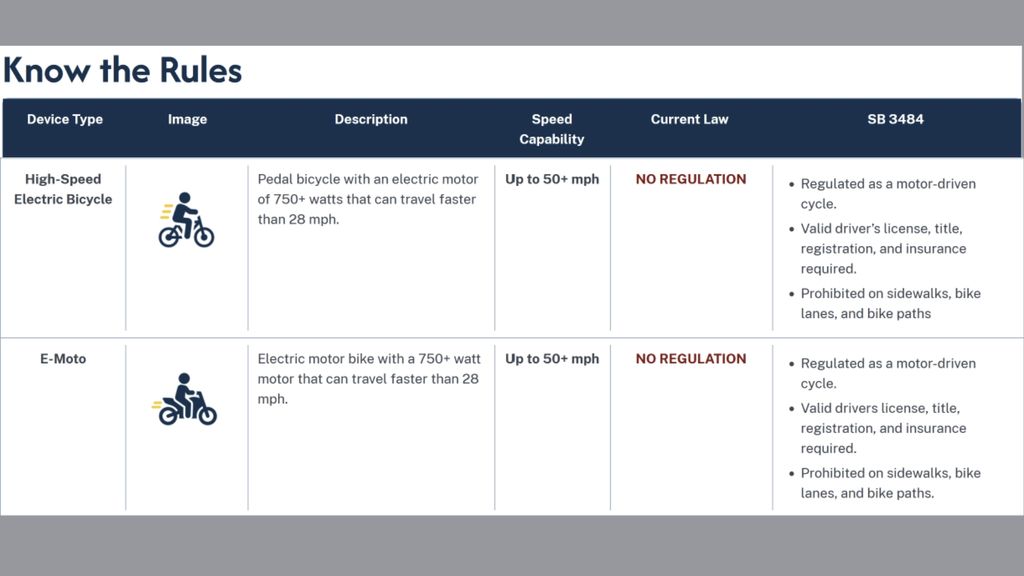
That's Right, Illinois Will Require High-Powered E-Bike Riders To Treat These Machines Like Other Roadgoing Vehicles
Liability insurance, a driver's license, vehicle title, and registration will be compulsory. And in case you're wondering about the insurance part of this question, and who offers e-bike insurance, guess what? All the usual major insurance companies you can probably rattle off the names of in your head like an in-brain commercial break just happen to offer e-bike insurance policies.
Quelle surprise!
Did any of them, by chance, have any small amount of input into drafting this legislation? That's unclear. However, if you've been an observant person for any length of time, it's quite possible that you, like me, can't help but ponder the possibility.
All E-bikes Ridden In Illinois Will Now Require Riders To Be At Least 15 Years Old
That goes for low-speed e-bikes in the Class 1 and Class 2 categories. For Class 3 e-bikes, riders must be at least 16 years old. Since the higher-powered e-bikes will now require drivers' licenses to legally operate, that will by definition also put a minimum age restriction on those riders as well. In the state of Illinois, a 15-year-old can get a learner's permit, but cannot get a full driver's license until the age of 16.
E-Bikes Classed As 'Low-Speed' (Class 1, 2, or 3) Will Maintain Certain Spaces Where They're Allowed And Not Allowed To Ride
While the minimum age restriction is about to change, where low-speed e-bikes are allowed/not allowed to ride statewide in Illinois will remain the same.
Sidewalks are prohibited currently, and will remain so going forward. Streets, bike lanes, bike paths, and shared-use trails will be allowed, with some exceptions I'll get into below.
SB 3484 Specifically Says That Local Jurisdictions Cannot Supersede State Micromobility Laws
This goes for all home rule jurisdictions, which are specifically called out in this bill. Local governments are required to comply with the state regarding the implementation of these rules, for the most part.
The one categorical exception is the Illinois Department of Natural Resources, as well as park districts, forest preserve districts, conservation districts, and transportation districts, which are all able to regulate the use of low-speed electric bicycles on any bicycle paths within their jurisdiction in the state of Illinois.
Riding Your E-Bikes Two-Up Will Come With New Restrictions, Too
According to SB 3484, if you ride a perfectly legal low-speed electric bicycle, you will now not be allowed to ride two-up if you're under the age of 18, "unless the passenger is a sibling, stepsibling, child, or stepchild of the operator." In other words, no more giving your buddy a ride to the park, your house, or anywhere else if you're under 18.
There's More To SB 3484 And Micromobility, Including New Rules For Electric Unicycles, Skateboards, and Scooters
We're talking standing scooters here, not the sit-down type (which you already need a motorcycle license to legally ride anyway). There are even new provisions for the operation of toy vehicles in the state, including banning modifications to make them go faster. In other words, crazy customs like this Power Wheels Lamborghini wouldn't be legal here.
For a handy overview, check out the IL SOS page regarding the upcoming changes here.
What Will Education About (And Enforcement Of) These Rules Look Like?
The stated intention of this legislation was to create a single, clear regulatory framework for every jurisdiction in the state of Illinois to adhere to. That concept is both understandable and needed, as so many cities, towns, and municipalities were all coming up with a variety of rules for what is and isn't allowed within their borders.
The trouble is, if you ride e-bikes, you know that you can get pretty far on them. Borders between towns can get squiggly and strange (let alone counties and other jurisdictional markers), and many times, you may not even realize you've gone from one to another right away.
Having a single set of expectations for the whole state should, at least in theory, make things clearer and easier, both for riders of all types of e-bikes as well as other micromobility devices.
The ILSOS states that it's working "to develop new programming and curriculum that address micromobility across K-12 education and within high school driver's education classes." It goes on to add that this curriculum "will focus on improving understanding of device classifications, current laws, and the safe operation of e-bikes and other micromobility devices, helping prepare both riders and drivers to share the road responsibly."
That all sounds reasonable, but I have a few followup questions.
One: What about everyone who's already past their time spent in K-12 education or high school driver's education classes? That's a whole lot of people who probably need to know these things as well; both as regular citizens going about their daily business, as well as law enforcement and local officials throughout the state. There's going to be a lot of confusion to go along with these changes; in fact, as I mentioned previously, there's already evidently been some confusion amongst other news outlets reporting on these changes (who I strongly suspect may only have read the press release and not the text of the bill itself).
Two: What will enforcement look like? This isn't The Matrix; law enforcement officers can't simply install a new set of directives into their brains and automatically all be on the same page about what changes have just occurred to state law. Misunderstandings, misapplications, and mistakes are bound to happen.
Three: In the text of the bill, there's a section stipulating that vehicles purchased prior to January 1, 2027 (whether they're electric-powered motor driven cycles or gas-powered bicycles) "need not mandatorily be titled." But utilizing a specific cutoff date, even if it's written to take place some months from the present, seems ripe for abuse. Not everyone is going to have the receipts for their e-bikes, particularly if they received them as a gift from Grandma or whatever. How can you prove a thing you didn't know you would have to prove, and thus had no reasonable expectation that you would need to retain receipts for?

RECOMMENDED FOR YOU

We Just Found Kawasaki's Robot Horse Patent Drawings. They're Full Of Insane Details
KTM Says Don't Ride These Husqvarna And GasGas Off-Road Bikes Because Of A Risk Of Death
The Superbike Factory Story Seems To Get Uglier, As Told By A Branch Manager
Sturgis Saw A 25% Decrease In Crashes This Year, While Drug Arrests Rose
A Major Used Motorcycle Chain Just Went Into Administration. Here's What That Means For Motorcyclists
This Is the Most Chaotic Motorcycle Police Chase We've Ever Seen
Looking For A Shop Manual For Your Small Engine Project? You Might Be Sleeping On The Best Resource