
Are Range Extenders the Answer to EV Motorcycle Anxiety? This Concept Thinks So
Here in 2026, pure EV motorcycles have size and energy density constraints that limit their capability. But what if that could change?

If you've never ridden an EV motorcycle before, I'm here to tell you that they are fun, as well as quick off the line. Even ones that don't have a very high top speed are usually plenty quick at first, simply by virtue of instant torque availability with the merest twist of your right wrist. Examples that can legit go fast, like the Zero SR/F, are of course even more fun to those of us who've been riding combustion motorcycles because we like going fast on two wheels.
Are there issues? Sure, there are plenty, but if we're speaking specifically about the concept of having fun, then that isn't one of them. They make different noises than combustion bikes (not no noise, contrary to what you may have been told), and you may feel differently about them for that reason. Prices are starting to come down now, with established industry players like Honda and Royal Enfield throwing their weight behind development of EV motorbikes that don't cost an arm and a leg.
That's good news, but what about the very real problem of range anxiety? Swappable batteries aren't a bad idea, but they do either require you to a) have your own spare batteries at both ends of your journey to swap out, b) carry an extra battery with you, which can be heavy and impractical (but it's something that e-bike riders already frequently do), or c) utilize a commercial battery swap-and-go network that may or may not exist in your area.
Seemingly alone amongst its competition, Kawasaki introduced the Ninja 7 and Z7 Hybrids a couple of years ago. These strong hybrid motorcycles combine both an EV component and a gasoline engine component, theoretically making their owners less dependent on whether gas prices are affordable, yet also ostensibly giving them freedom from EV range anxiety.
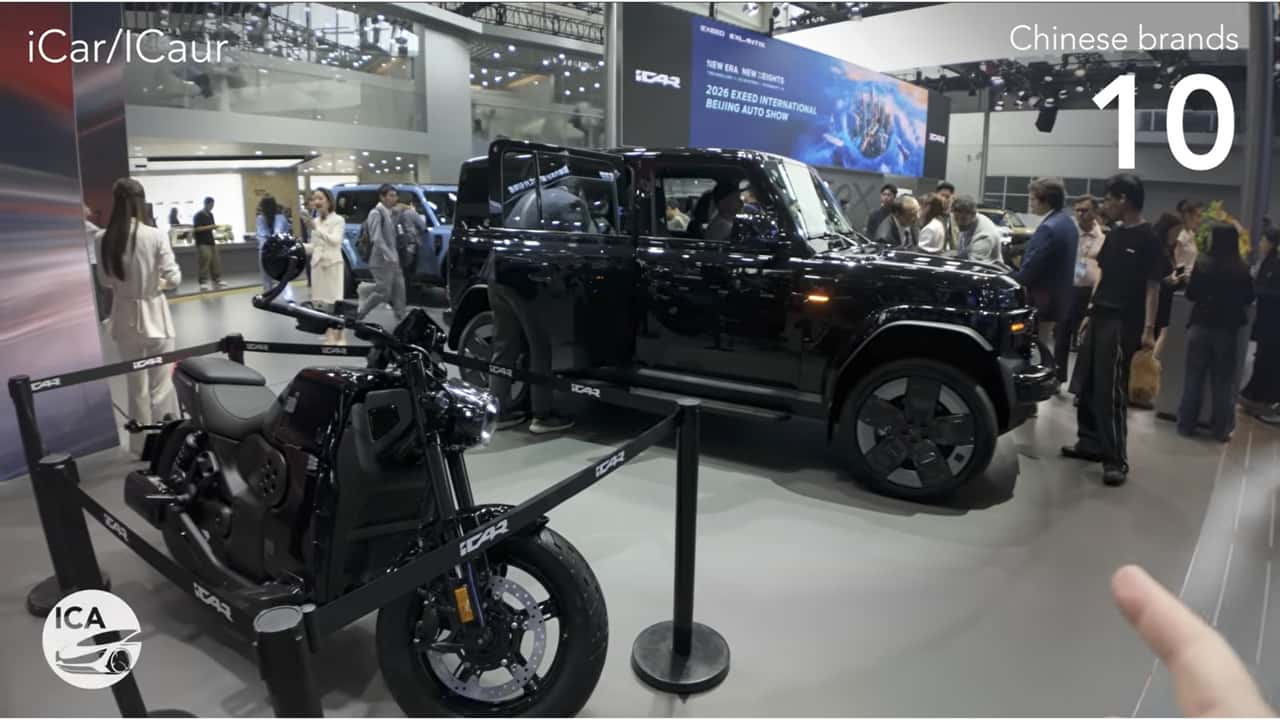
And now, at the 2026 Beijing Auto Show, mega Chinese automaker Chery just introduced its first-ever motorcycle concept, through its already-existing iCar sub-brand. Only, it's not just Chery's first-ever motorcycle; it also happens to be a range-extended EV (REEV) concept. In other words, it's a bit of a hybrid. Say what?
Over on the automotive side of things, REEVs aren't a new concept (see the BMW i3 REx, for example). But in motorcycles, they're pretty unheard-of. While Chery has seemingly positioned this motorcycle as an unassuming concept that almost seemed like an afterthought in its showfloor-space presentation (see the video above to see what I mean), it poses an interesting proposition to address where the technology is at this point in time.
The Best Of Both Worlds?
Looks-wise, it appears at first glance to be not too dissimilar in silhouette to the Honda WN7. But unlike the WN7, this cheeky little guy proposes hosting a small gasoline engine to extend the effective range a rider can accomplish before needing to recharge. Although solid-state batteries could potentially make a massive difference in the EV motorcycle space, we also need solutions that work today while we're working on the ones for tomorrow, never mind the prohibitively high costs that usually come with being on the bleeding edge of any new technology.
If you're wondering who Chery is, the company is a massive Chinese automotive manufacturer that makes reasonably-priced EV automobiles. As the excellent Kevin Williams over at InsideEVs relates, when they first brought their vehicles to Australia, they had serious quality control issues that were bad enough that the company left the market entirely. Interestingly, though, it seemingly took the time away to regroup, reapply itself, and also seriously up its quality-control game before re-entering the Australian market in 2023. And now, it's a legit EV player, offering vehicles with competitive quality and features to potential customers.
As is fairly common among automotive OEMs, Chery has a sub-brand called iCar that it uses to market some of its EVs, and it's through this brand that it brought its very first motorcycle concept to the 2026 Beijing Auto Show.
While it's unclear when or if it might make this concept a production bike, there's no reason to believe that it couldn't. As China Motor World reported in January 2026, it appears that Chery is, in fact, planning to enter the motorcycle segment even though it hasn't done so previously. Motorbikes are a major form of transportation in most of Asia, and EV motorbikes in particular are becoming more and more important as cities and countries across the region seek to curb emissions.
It's also not an unprecedented move for a Chinese automaker to dive into also making motorcycles. Surely you've heard of QJMotor before? In case you aren't aware, that's a sub-brand of the mega automaker Geely, which currently owns both Volvo and Polestar.
Will this concept eventually see the light of day as a production machine, in some form? Should EV motorcycle makers explore range extenders as a stopgap measure? Both of these things are unclear at this point, but they're definitely food for future thought.

RECOMMENDED FOR YOU

You Don't Need This Givi Accessory... Until You Actually Use It
Polaris' New UTV Has More Horsepower Than Subaru's WRX. Rally Nerds, Rejoice
Pirelli Wants to Recycle Your Old Tires And Make New Ones
Sidecar Racing May Return To The Isle Of Man TT Next Year After Two Horrific Accidents
Yamaha Aims to Build a Hydrogen-Powered Sauna Boat. Yes, You Read That Right
Kawasaki Unveils 2-Seater Teryx H2 UTV. It's Still Supercharged Insanity
A Cut-In-Half E-Bike Makes A Dope Backcountry Hauler, As Well As Keeping a Family Hiking Together