
Does a Superbike-Swapped Suzuki Off-Road SUV Make Perfect Sense? Yes
A lot of people adore the adorable Suzuki Samurai for its pint-sized off-road prowess. But what if you stick a different Suzuki engine into it? What happens when you stick a Suzuki Hayabusa engine into a Samurai?
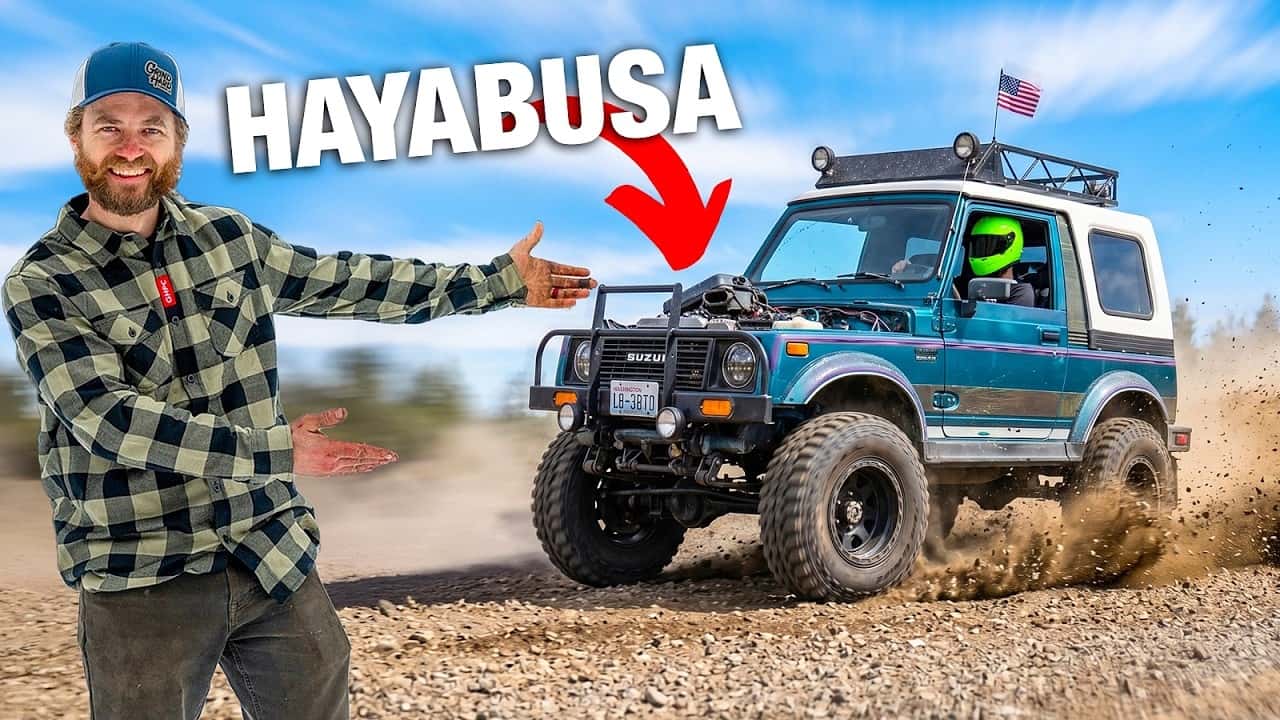

Suzuki's diminutive Samurai off-roader has a cult following. For years, people have sworn by its off-road capabilities, even when most folks have full-size SUVs, trucks, or the new hotness that RideApart covers, UTVs. And it's easy to see why.
The Samurai was lightweight, agile, compact, and pretty damn bulletproof right out of the box when it was first introduced many decades ago. It's a proto-UTV in the same way that Tiktaalik was the proto-land animal—yes, I'm giving you deep evolutionary biology cuts.
But if there was one downside to the Samurai, it was probably its engine, in that it was often a wheezy, naturally aspirated, three-to-four cylinder engine. Basically, while the rest of the SUV was overengineered, the engine was a dog. Yet, what would happen if you changed that? No, I'm not talking about the lunatics who LS swap these things, though that happens, but what if you stayed within the Suzuki family? What happens when you go to an engine that's so ubiquitous and so powerful that nearly everyone knows of at least one build with it?
What happens if you Hayabusa-swap a Suzuki Samurai? You get the above.
Make Some Noise
The build comes from none other than the good folks over at Grind Hard Plumbing Co., the loose group of insane welders and engineers who are responsible for some of the most insane projects this side of the Mississippi. They built the wild three-wheeled monster trike, numerous Hot Wheels powered by motorcycle engines, and everything in between. And the Suzuki Hayabusa engine is often their go-to for doing something mad, which is exactly what you get when you cross a Samura with a 'Busa.
To put this into perspective, the Samurai's most powerful engine topped out at about 80 horsepower. The Hayabusa's engine was routinely over 180 horsepower. We're talking about doubling the Samurai's power output and then some, all while increasing its rev limit by a factor of a bazillion. The end results is something that is truly fantastical, though there are some hiccups along the way. As well as some very leaky fuel tanks...
I won't spoil the end, but you know you need to hear what a Hayabusa-swapped Suzuki Samurai sounds like. Check it out above.

RECOMMENDED FOR YOU

The 2027 Suzuki Hayabusa Special Edition Is A $700 Paint Job With Main Character Energy
A Tribute To Oscar-Winning Irish Musician Glen Hansard, Who Passed Away in a Motorcycle Accident
The New V-Strom 250 Proves Suzuki Can Modernize Anything Very, Very Slowly
Guy Martin Never Won The Isle Of Man TT, But You Can Buy The Bike That Got Him Closest
Get Excited, Suzuki's Brought Even More Motorcycles Back This Year
GoPro Just Partnered With American Flat Track Racing Amid Serious Business Trouble
It Sure Looks Like Suzuki Might Help Bring American Robocars To India