
Shoei Found a Problem With Modular Helmets, So It Fixed It
Shoei’s solution not only makes modular helmets supposedly safer, it makes them better looking, too.

Modular helmets are a bit like the Swiss Army knives of the riding world. They’re not quite full-face, not quite open-face, but something in between. Need the protection of a full-face helmet on the highway? Done. Want to flip it open to talk to someone or grab a drink without taking the whole lid off? Easy.
This is exactly why modular helmets have exploded in popularity, especially among touring riders, commuters, and anyone who values a bit of convenience on the road.
But modular helmets aren’t perfect. While they offer loads of versatility, the design comes with compromises. One of the biggest? The way the chin guard and face shield connect to the main shell often creates bulky hinges, visible seams, and awkward angles that can mess with airflow, or worse, create potential weak points in a crash.
Interestingly, this was something pointed out by Shoei in a recently filed patent.

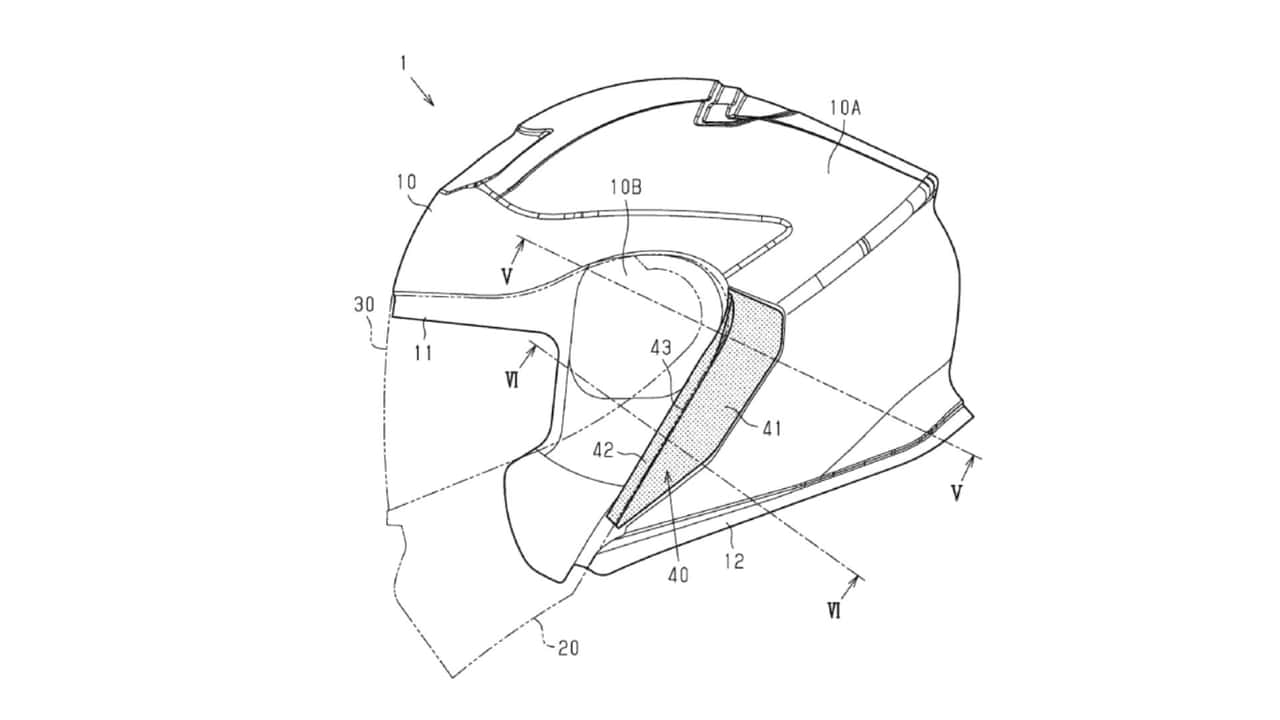
The design focuses on an additional curved piece that smoothens the transition between the main shell and the visor and chin bar.

The Japanese helmet manufacturer outlines a new way to design a modular helmet that smooths out those rough edges—literally. Instead of letting the moving parts attach directly to the helmet shell and leave behind an abrupt step, Shoei’s idea is to insert an extra component: a kind of transition piece that bridges the gap and blends everything together more seamlessly.
If you look at the drawings, the concept becomes clearer. The helmet’s outer shell still has the usual round contour, but instead of sharp angles or exposed mounting points, there’s a recessed section that gently slopes outward. This slope, called the “second attachment surface,” according to the patent, is where a new exterior piece is fitted. That piece—essentially a curved panel with its own subtle ridge-line—covers the joint between the shell and the flip-up parts like the chin guard and shield, smoothing out the shape and minimizing the visible transition.
The result is a helmet that not only looks cleaner and more aerodynamic, but may also disperse impact forces more effectively in the event of a crash. Shoei also points out some manufacturing benefits—like more consistent shell thickness, which makes molding easier and helps evenly distribute materials like fiberglass or composite fiber layers.
Here's a closer look at the curved panel meant to ease the transition between the chin bar and main helmet.
Of course, this isn’t a radical overhaul of how modular helmets work. You’ll still get the same flip-up functionality and protective performance. But Shoei’s approach is all about refinement—chasing smaller improvements that add up. And given its track record with high-end lids like the Neotec II and RF series, this is very much in character for the brand.
So is this something riders absolutely need? Not necessarily. Modular helmets are already safe, functional, and more comfortable than ever. But Shoei’s solution addresses a subtle flaw that most riders probably never noticed—yet it’s hard to unsee once it’s pointed out. It’s one of those clever design tweaks that doesn’t demand your attention, but quietly makes a good product even better.
That said, I wouldn’t be all too surprised if we see this technology in practice pretty soon—perhaps in the next generation of Shoei’s Neotec modular helmet range.
Keep Your Head In The Right Place
Source: Shoei via WIPO
RECOMMENDED FOR YOU
The Next 'Motorcycle Rider Aid' Might Be The One That Won't Let You Speed
KTM's Rivals Say "Fine, You Can Fix Your Broken MotoGP Engine"
onX Wants To Make It Easier To Make Your Voice Heard On Public Land Issues
It Was Easy to Build Zero Motorcycle's New XE Dirt Bike In My Garage
Amazon Wants to Connect Your Phone Everywhere, Whether You Want Them To Or Not
Royal Enfield's One Ride 2026 Is Coming. Here's What You Need To Know
You Don't Need This Givi Accessory... Until You Actually Use It