
BMW Patent Shows Adaptive Aerodynamic Element Design For Future Bikes
Riders of bikes outfitted with these elements won't have to do anything but ride.
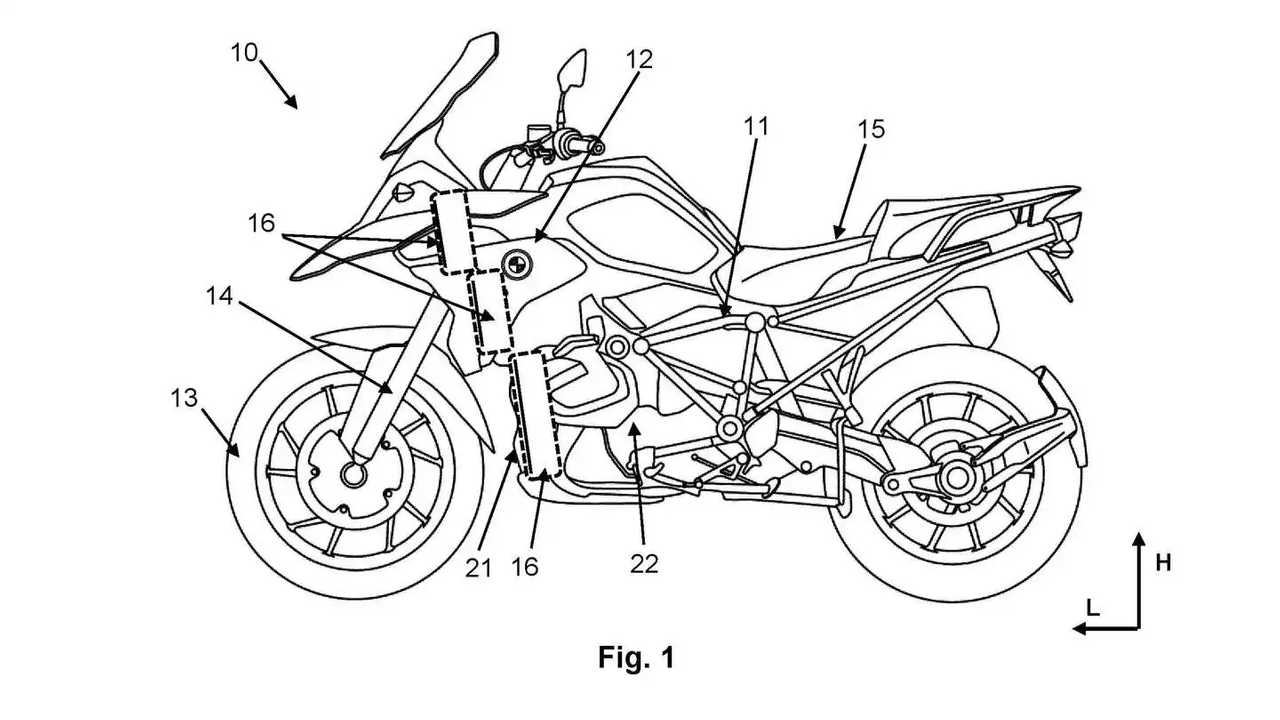

You don’t stay on top of your game in the motorcycle industry, like BMW has, without constantly developing new features to entice riders. Take this recently published patent document (as filed with the German patent and trademark office), which demonstrates a seemingly simple, streamlined adaptive aerodynamic system. It was first filed in August, 2021, but wasn’t officially published until the end of March, 2022.
In the case of some patents, drawings and text must be taken together for a full understanding of what the thing being patented is meant to do. However, in the case of this particular patent, the drawings themselves mostly make it pretty clear how the device is meant to work. BMW’s drawings show a motorcycle in the GS family demonstrating anywhere between one and three adjustable air-guiding elements mounted on the front fairing.
The text goes on to say that BMW might choose to use this device on any type of motorbike, having anywhere from two to four wheels (really, they say four wheels are a possibility). Furthermore, anywhere from one to three of these devices might be deployed on each side of the vehicle in question, to direct airflow evenly as a vehicle is moving forward.
Gallery: BMW Motorrad Adaptive Aerodynamics Patent


How do they work? According to the patent, a combination of springs and vehicle speed automatically adjusts the air-guiding elements as a person is riding from place to place. Thus, no action—or distraction, more importantly—is required on the part of the rider.
When a rider is either moving slowly or is completely stopped, the air-guiding elements will stick out a bit more, helping to guide air (and probably also rain) around vehicle and rider. As a rider’s speed increases, the air-guide elements get pushed back, depressing the springs and streamlining (rather than deflecting) the airflow.
Could BMW choose to use this on the upcoming R 1300 GS? While it’s certainly not clear at this point that it will, it certainly could choose to do so if it wanted. As BMW itself spells out in the patent document, the patent is for the air-guiding element itself, not for its use on any specific vehicle, or even in any specific quantity on any particular vehicle. That means, if BMW feels it’s advantageous, it could choose to use such elements on any motorbike it wishes—including a future iteration of the CE-04.
More BMW:
Source: WIPO
RECOMMENDED FOR YOU
This V8 Racecar Made to Dominate Pikes Peak Uses Welded Together Superbike Motors, and One Big Turbo
Volkswagen Doesn't Deny It's Looking To Sell Ducati In Official Statement
Demand For BMW's New Small Off-Road Motorcycle In India Is So Crazy, They Stopped Orders
This Adorable Little UTV Just Got Drafted By the Army. Needs Some Super Serum
KTM Just Poached Another BMW Motorcycle Exec To Fix Its Rocky Ship
‘Mexican Batman’ Is Duct-Taping Motorcycle Thieves to Lampposts. Muy Bien
Vespa Sets Design Powers To Stun For Its 80th Birthday. Look At This Limited Edition Scooter